Sibu is an inland town, and the capital of Sibu District (229.8 square kilometres)
. It is a town built on the banks of the mighty Rajang River which is located at the confluence of the Rajang
and Igan Rivers. Sibu also known as the Swan City. The population is dominated by the Chinese especially the Fuzhou as well as indigenous Melanau, Malay, and Iban. The town population (year 2010) is 257,800.
Sibu is the main tourist gateway to the Upper Rajang River, with its small riverine towns and its many Iban and Orang Ulu
longhouses.
There has been a marked increase in public buildings in recent years. Sibu now boasts the
largest town square in Malaysia, and the tallest building in Sarawak is the Sanyan Tower also can be called "Wisma Sanyan" in the official Malay language),
a newly refurbished waterfront and a large number of public parks.
Sibu
also has university-level courses offered by Laila Taib College
(previously known as United College Sarawak), which has built a campus
on the site of the old Sibu airport.Currently, there are another University which still build in progress that is University College of Technology Sarawak (UCTS) which located opposite Laila Taib College and beside The Stadium.
In 2010,Sarawak Government had
announced that Sibu will have its own Sarawak Islamic Complex
Building,the second in the state after Kuching.
Sibu Jaya, which is located 25 km away Sibu Town, is being developed as a satellite town. Sibu Airport, was relocated to its present site 23 kilometres from town near Sibu Jaya in 1994.The first airport in Sibu was built in Teku,during World War II by the Japanese as a basic air strip.
History
Establishment
Before 1 June 1873, Sibu was known as "Maling", named after the winding portion, "Tanjung Maling", on the other side of
Rajang River. Maling was a small village with a few small and simple shop houses with
atap roofs and wooden walls and floors. The main population was Malay; and Chinese were in a minority.
In 1841 "Sarawak" (the present Kuching - Sarawak Capital) was ruled
by 'White Rajah', James Brooke. On 1 June 1873, the third division was
created and the division was named after the native
rambutan fruit because the division had a lot of native rambutan known as "Buah Sibau" in the Iban language.
_by_Francis_Grant.jpg) |
| Sir James Brooke (1803–1868) |
In 1901
Wong Nai Siong (Huang Naishang) led the first batch of
Foochow
Christians from China to Sibu to open up the fertile lands of Sibu for
cultivation, a massive opening up of Sibu. This was a landmark year in
the history of the development of Sibu.
Wong Nai Siong
came to Singapore in September 1899. From there, he proceeded to West
Malaysia, Sumatra and the Dutch East Indies. For six months he explored
the places but failed to find a suitable place for the immigration and
settlement of his folks in China. In April 1900, Mr. Wong Nai Siong came
to Sarawak and got the approval of the Sarawak Rajah to look for a
suitable site for Chinese immigrants.
Wong explored the lower valley and upper reaches of the Rajang River.
He soon discovered that the Rajang Delta was very fertile and
particularly suitable for cultivation. So he decided to choose the area
for opening up for cultivation. With that decision, Mr. Wong went to see
the second Rajah of Sarawak, Rajah Charles Brooke, for discussions
regarding the matter of opening up of land for cultivation. In those
days of the Rajahs, Sarawak was sparsely populated with vast land yet to
be developed, Wong's plan was timely and very much appreciated.
So, when
Wong Nai Siong
went to see Sir Charles Brooke and explained to him his plan to lead
large groups of Foochows to open up Sibu for cultivation, the Rajah
immediately agreed. Both parties signed an agreement.
[4]
The Chinese immigrants came in three batches. The first batch
consisted of 72 people, the second batch 535, and the third batch 511,
totalling 1118 people. Of the total, 130 brought their spouses and
families, while the others were bachelors. After working in Sibu, nearly
all the immigrants chose to settle down and made Sibu their new home.
They were happy to settle down for a brighter future in Sibu.
 |
| Wong Nai Siong (1849─1924) |
Sibu Fort
There used to be a Sibu Fort, which was built by Rajah Brooke in
1862. The fort was located at Race Course Road, however it no longer
exists now. It was common for the
White Rajah to build such forts to stake his territorial claim as well as means of protection.
The existence of Sibu Fort is proven by historical writings:
| “ |
...There is a fort in Sibu,
as indeed there is at most of the river places in Sarawak. The fort at
Sibu was close to the Resident Dr. Hose's house and was attacked by
Dayaks only a few years ago. Johnson, one of Dr. Hose's assistants,
showed me a very long Dayak canoe capable of seating over one hundred
men...
The river at Sibu was of great width, over a mile across, in fact,
and close to the bank is a Malay village, and a bazaar where the wily
Chinaman does a thriving trade in the wild produce of the country, and
makes huge profits out of the Dayaks and other natives on this river.[5] |
Rosli Dhoby
Rosli Dhoby, a Sarawakian nationalist, is one of the more illustrious sons of Sibu. He is well known for his assassination of
Sir Duncan George Stewart, the second governor of colonial
Sarawak in 1948. He was then sentenced to death by hanging and was buried at the
Kuching Central Prison
in 1950. After 46 years of his remains resting in the prison compound,
it was moved out from the Kuching Central Prison and buried at the
Sarawak's Heroes Mausoleum near
Sibu Town Mosque on 2 March 1996.
In order to honour his involvement in the anti-colonial movement and
his struggle against the British, he and his associates who were
involved in the assassination (Awang Ramli Amit, Bujang Suntong, and
Morshidi Sidek) were later given a full state funeral by Sarawak
Government.
 |
| Rosli Dhobi (1933–1950) |
Population
The population of Sibu experienced a slower growth rate compared to
other towns and cities in Malaysia. There are many reasons resulting in a
decline in the Sibu population.
However, the real numbers of people living today in Sibu is much
higher due to high numbers of individuals not being counted in the
census who live and work in other cities and countries.
[6]
| Year |
1970 |
1980 |
1991 |
2000 |
2009 |
2010 |
Total
population |
50,635 |
85,231 |
133,471 |
166,322 |
209,616 |
257,800 | | | |
Tourism
The attraction that can attract people to visit Sibu are:
National Chinese Cultural Festival
The United Chinese Association (UCA) Sibu holds its pride for
hosting the 18th and the 26th National Chinese Cultural Festival. The
cultural festival has always been officiated by the Prime Minister of
Malaysia. Cultural village and the Lantern Riddles are among the
activities organised during the festival.
Borneo Cultural Festival
Sibu played as a host to the Borneo Cultural Festival, A week-long celebration of food, music and dances celebrating the
diverse cultural background of Sibu community such as Iban/Bidayuh/Orang
Ulu (Dayak Pavilion), Malay/Melanau and Chinese in 2005. BCF stands as Sibu biggest tourism event. If you want to taste the local
native traditional food, you should visit local native booth during
BCF. The organising committee has line up lots of attractive programs
and activities for the visitors. A showcase of rich racial and ethenic culture in the region. Promoting
Sibu as a gateway to the central of Sarawak and playing its role to
realize the Vision of Sibu in becoming city of cultural and festival. Since then, it has become an annual
occasion and a trademark of Sibu. However,for the first time ever since
the creation,it will not be held in 2011; which caused waves of protests
from locals, including key players in Sibu Tourism Industry. However, Sibu
Municipal Council announced that 2011 BCF is postponed to 2012, after
discussion with State Government and in 2012, BCF was held from 6 June to
15 July 2012. Once again, in 28/06/13 until 07/07/13 BCF have been held at Sibu Town Square. It is free show for the public at Sibu Town Square. Just walking distance from all major hotel in the town centre.
 |
| Banner for BCF 2013 |
|
|
 |
| Credit : http://www.sarawaktourism.com |
|
Swan Symbol for Sibu
In order to promote itself to tourists and for branding purpose, Sibu Municipal Council under the former Chairmanship of Datuk Robert Lau Hoi Chew, adopted the swan
as the symbol of Sibu town. According to the Sibu Chinese community,
when the early immigrants arrived in Sibu in the mid 19th century and
early 20th century, the present Rajang River reminded them of Swan River
in Fuzhou, China. However, due to the fact that such a bird is
non-existent in the town (except for the numerous huge artificial swan
statues) or anywhere in Malaysia, the majority of the Sibu community,
especially the natives, feel that such a choice is too artificial and
does not invoke any special or deep feeling toward the so-called "Symbol
of Sibu".
Visit Sibu Year 2009 & Pandaw River Cruise
Year 2009 was declared as '
Visit Sibu Year 2009', to boost the tourism industry in the central region. A new attraction is
Pandaw River Cruise,
which was started on 1 July 2009. This is a nine-day cruising up the
Rajang river deep into the Pelagus Rapids Resort in the rural interior
of Sarawak with Sibu Express Wharf Terminal as the first stop. The
tourists in the cruise can enjoy the scenery of the tropical rainforest
as well as visiting traditional and modern longhouses.
[8]
However, In March 2012,the river cruise ceased its operations due to poor respond and also high operating costs.
Sibu BASE Jump
B.A.S.E is an acronym for building, antennas, spans (bridges) and earth
(cliff) and BASE jumping is actually refer to an activity that employs
an initially packed parachute to jump from these fixed objects.
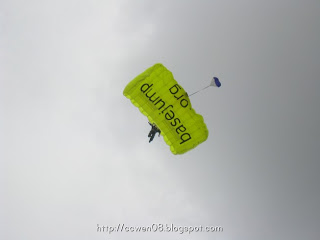
Sibu BASE Jump 2009 is the first ever BASE jumping event held in Sibu
town. The venue for this BASE jumping with no doubt is the tallest
building in Sarawak at the moment - Wisma Sanyan which consists of
27-storey or 126 meters height. The annual event was held at Wisma Sanyan, Sarawak's highest building, and participated by professional BASE Jumpers. Sibu Base Jump 2012 took place from 20th to 23rd September at Wisma Sanyan, which 28 Base Jumpers from 7 countries completed 761 Base Jumps during the event. Sibu BASE Jump 2013 will take place from 19th to 22nd September. Jumping
will be off Wisma Sanyan on the island of Borneo in Sibu, Sarawak, East
Malaysia. Standing 126 meters high Wisma Sanyan is the tallest building
in East Malaysia. The welcoming atmosphere and hospitality in Sibu is the best we have
experienced in Malaysia. This is a very unique and highly recommended
event to attend.


 |
| Credit : http://ccwen08.blogspot.com |
Landmarks
The first highrise building in Sibu was the Sarawak House hotel and shopping complex, built in the early 1970s by a group of local businessmen. Among the interesting landmarks in Sibu are Wisma Sanyan, a 28-storey building, which is the tallest building in Sarawak[3] (to be surpassed by Kuching Tower soon), Tua Pek Kong Temple and the Central Market. The completion of RH Hotel and Kingwood Hotel which has been expand, in order to meet the tourism aspiration of the town. An
18-storey building has been build
next to the original site of the hotel.
 |
| Kingwood Hotel after the expansion |
 |
| Central Market sibu |
Eng
Ann Tua Pek Kong of Sibu was founded around 1870. From the original
wooden structure of a Chinese temple. It was rebuilt in 1897 into Taoist
architecture building. Most of its building materials were imported
from China including the statue of the host deity, Lord Tua Pek Kong.
Like
the other Tua Pek Kong temples in Sarawak, Eng Ann Teng Tua Pek Kong
temple has met some major fire disasters in Sibu. But it did not suffer
any damages. Even the Sibu big fire of March 8, 1928 which destroyed
most of surrounding shop houses, left this Temple unscathed.
 |
| Tua Pek Kong Temple Sibu |
The Civic Centre Museum
(its official name was Dewan Kebudayaan dan Warisan;Cultural &
Heritage Hall in English) had a display of Sibu's history, and Melanau,
Iban, Malay, and Chinese artifacts and has been relocated to the new
Sibu Cultural & Heritage Centre.
 |
| Civic Centre Museum |
The YMCA Resort is an outskirts resort getaway for camping and retreat.
The Sibu Heritage Trail
The Sibu Heritage Trail at the
Sibu Heritage Centre here was launched in June, 2012
he trail was another initiative of the Sibu Municipal Council to
promote Sibu as a city of cultures and festivals and a gateway to
the central region of Sarawak.
Sibu Heritage Trail consists of nine heritage sites including :
1) Sibu Old Mosque,
2) Masjid An-nur,
3) Rosli Dhobi Warriors Memorial,
4) Old Muslim Cemetery,
5) Lau King Howe Hospital Memorial Museum,
6) Hoover Memorial Square,
7) Tua Pek Kong Temple,
8) Sibu Central Market
9) Sibu Heritage Centre.
The whole trail loop measuring about 4km and took about an hour and
half if one made brief stops at all the heritage sites.
.
With its earliest settlement dating back to the 1800s, followed by
the early immigration led by the late Wong Nai Siong, Sibu has grown
by leaps and bounds into a major urban centre in Sarawak.
All the heritage sites identified are of great significance in the
development of Sibu town.
Another landmark is Old Sibu Municipal Council building,
where formerly housed the Sibu Municipal Council Office and Public
Library (before moving to its current building at Jalan Keranji in 1986)
is now known as Sibu Heritage Centre (SHC) which houses the exhibits previously exhibited at the Civic Centre Museum.
This
building has witnessed the transformation of Sarawak from a colony of
the British to becoming an independent state by forming Malaysia in
1963. Sibu Heritage centre was the original administration building of
Sibu Municipal Council. It was later refurbished as Sibu Heritage centre
Museum. Its upper floor houses the Sibu heritage museum. The ground
floor is a commercial belt. There is also a space for artwork
exhibition
 |
| Sibu Heritage Centre |
The Lau King Howe Hospital Memorial Museum
is the first medical museum in Malaysia, one of the oldest hospitals in
Sarawak. It exhibits medical equipment and uniforms used by medical
staffs at Lau King Howe Hospital.
 |
Lau King Howe Hospital Memorial Museum
|
Sibu Old Mosque (Masjid Lama Sibu)
This
old mosque of Sibu has been here since 1883.Its first as a wooden
structure was built by Tuan Haji Abdul Salam Minangkabau from Indonesia.
However, its structure is never changed; its original form remains intact.
Warriors Memorial site
Rosli
Dhoby, born in Sibu, was an active member of one Sibu – based Malay
Youth Movement (Gerakan Pemuda Melayu). On 3rd December, 1949 and at the
age of 17 years Old, Rosli Dhoby led a group, codenamed the Rukun 13
(the Black Crow group). They set off to assassinate the 2nd Gorvener of
Sarawak, Mr. Duncan Steward. Rosli Dhoby and 3 others, namely Morshidi
Sidek, Bujang Suntong and Awang Ramli Amit were arrested and hung. They
were buried in Kuching on 2nd March, 1950. 46 years later, their remains
were exhumed and brought back to Sibu.
They were re – buried at this Warriors Memorial Site on 2nd March, 1996.
An – Nur Mosque (Masjid An- Nur)
This
An-Nur Mosque was built to replace the Sibu Old Mosque to cater to the
increasing Muslim population of Sibu. The State government of Sarawak
provided the land, and its foundation stone was laid 15th December 1981.
An-Nur Mosque has a 93 – foot tall tower. Its gold coated dome has a span of 63 feet in diameter reaching a height of 35 feet.
Oldest Muslims Cemetery (Sibu town Square phase 2)
This
oldest Muslim cemetery site was estimated to have buried over 70
Muslims. However, the burial activity was stop during Japanese
occupation in 1941. Over time, river bank erosion has caused some severe
damages to the site. It was restored in 2003.
The two
Angsana trees are said to be the temporary “Batu Nisan” or tombstones
for one tomb. As most of the original tombstones were washed away, a
memorial structure was later erected to commemorate it.
 |
| Hoover Memorial Square |
This
square is named after a great Methodist Missionary (from USA), Reverend
James Matthew Hoover. Reverend Hoover was the first foreign pastor who
served the Methodist Churches of Sibu. From 1903 to 1935, he had helped
to build 41 churches and 40 schools all over Sibu. When the Fuzhou
settlement pioneer, Mr. Wong Nai Siong, left Sibu in 1904, Rev. Hoover
helped to manage the settlement. His contributions to the early
development of Sibu were fondly and gratefully recognized.
Sg. Merah Baazar, The Herritage Walk
Wong Nai Siong Memorial Garden was
build by Sibu community who felt deeply grateful to his bringing
their forefathers to Sibu.
This memorial garden is next to the
landing point of Mr. Wong Nai Siong.
Sungai Merah is also where Wong Nai Siong Memorial Park is located. This
park is to commemorate the contribution of Wong Nai Siong to the people
of Sibu. A century ago, the Foochows begun arriving here with Chinese
scholar Wong Nai Siong at the invitation of the White Rajah to cultivate
food in Central Sarawak to feed the swelling local population.
The first batch of 72 Foochows arrived in Sibu in 1901 through the
arrangement of Chinese scholar Wong Nai Siong. Although agricultural
activities were unsuccessful in the initial years, the settlers
perservered. They started to prosper when Rev James Hoover (there is
another memorial park for Rev James Hoover in Sungai Merah), a Methodist
missionary, brought in rubber seeds from Singapore.
A Heritage Walk had been constructed along the river passing through
Sungai Merah and Wong Nai Siong Memorial Park form part of the Heritage
Walk. This is an overview of the Heritage Walk. The layout board is
rather faded and should be replaced.
Behind the memorial park is a round square called the "Landing Point". I
guess this is the spot where the Chinese immigrant first landed.
Across the road, there is a small arch, called "Sungai Merah Gateway".
Sungai Merah means "Red River". According to the legend, the river
(Seduan River) once flow across here used to be red in colour.
The most prominent structure at this heritage walk is the Lovers Bridge.
Built across the river and connecting the two pathway along the
heritage walk.
Since it is called Lovers Bridge, many couples will walk across the bridge at night and enjoying the surrounding view at night.
 |
| Credit : http://lifemixx.com |
This is what they called Pirates Esplanande. It's just wooden plank and 2 masts behind the ship's structure.
The Riversteps is the access point to a boat to navigate along the
river. It is also nice just to sit on the steps and enjoy the river
flow. It's usually high tide at night and it is easier to berth a
"sampan" or speed boat here. Note some construction work at the
background. Looks like more new shop houses will be built surrounding
this heritage walk
 |
| Credit : http://borneotip.blogspot.com |
Bukit Aup Jubilee Park Located some 12 km from the town. The
popular attraction of the park is its lake, which have lots of fish and
you can feed them. Also, the park is popular for hiking. Once you reach
the top of the hill, you can enjoy the view of Igan river and the town.
Sibu Lake Park located uptown. The park comprises an area of 11
acres lake, footpaths, jogging tracks, boat house, habitate island, bird
sanctuary, barbeque and picnic areas, spash pool, canteen, jetty and
others.
Credit also to :
- wikipedia
- http://www.etawau.com
-http://wikitravel.org


